The source stays the source
The workbook you were sent is kept as an original. Imported rows are never edited — adjustments, splits and overrides are separate records that carry their reason.
Forty Seven Lab · 47 Financials
47 Financials reads a current-year trial balance and last year’s signed report, maps every account to a statement heading, reconciles the movements and validates the arithmetic — then prepares the report from the figures you approved.
Rendered from the demonstration engagement — FY 2025 with FY 2024 comparatives, every figure traceable to a source row.
What it is
It is not bookkeeping software and it is not a dashboard over a ledger. 47 Financials works on the part of the engagement that is repetitive but unforgiving: turning a trial balance plus a prior-year signed report into statements that foot, a PPE note that reconciles, a validated comparative column — and then a report that was built from exactly the figures that were approved.
The workbook you were sent is kept as an original. Imported rows are never edited — adjustments, splits and overrides are separate records that carry their reason.
Financial position, profit or loss, equity, cash flow and the PPE note are built from mapped accounts, so a change to a mapping flows through every statement and the report.
The application prepares, reconciles and checks. It does not form an opinion, and it does not approve its own output — that stays with the accountant.
Source in: trial balance (.xlsx, .xls, .csv) · prior-year signed report (.pdf, .docx) · the firm’s report template
Output: financial statements with comparatives · notes · structured audit report · versioned DOCX and PDF
Follow the workflowThe product
The order matters: sources are confirmed before they are interpreted, mappings are resolved before statements are built, movements are reconciled before validation, and validation passes before anything is approved or produced. Every panel below carries the engagement’s own data.
01Source documents
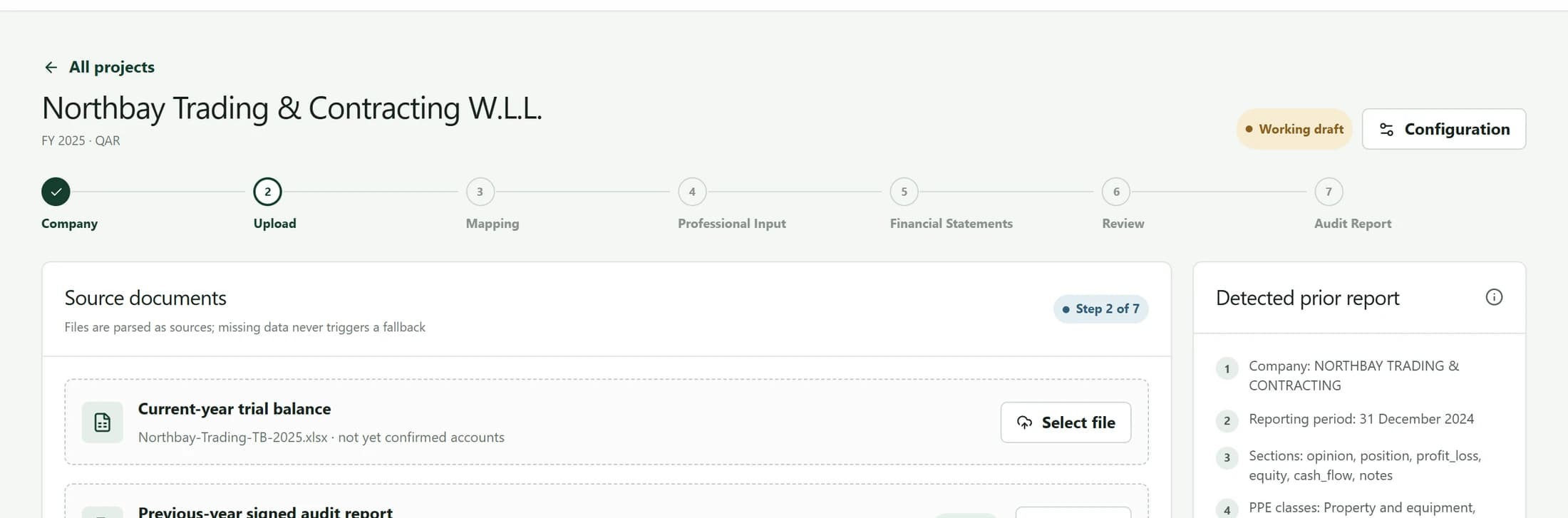
A current-year trial balance (Excel or CSV) and the prior-year signed report (PDF or DOCX) are uploaded as sources. The workbook's worksheet, header row and amount columns are confirmed explicitly — the application will not silently choose them for you.
02Trial balance
Import happens through the numbers themselves: debit total, credit total and the difference are shown as figures. Duplicate account codes and rows with no description are listed by source row, so a broken workbook is visible at the start of the engagement rather than after the statements are prepared.
03Classification
Each row is matched to a primary financial-statement heading and, where relevant, a note detail. Deterministic rules and prior-report matches suggest the classification, and the suggestion keeps its source and confidence on screen — so the reviewer can see why a heading was proposed.
04Construction
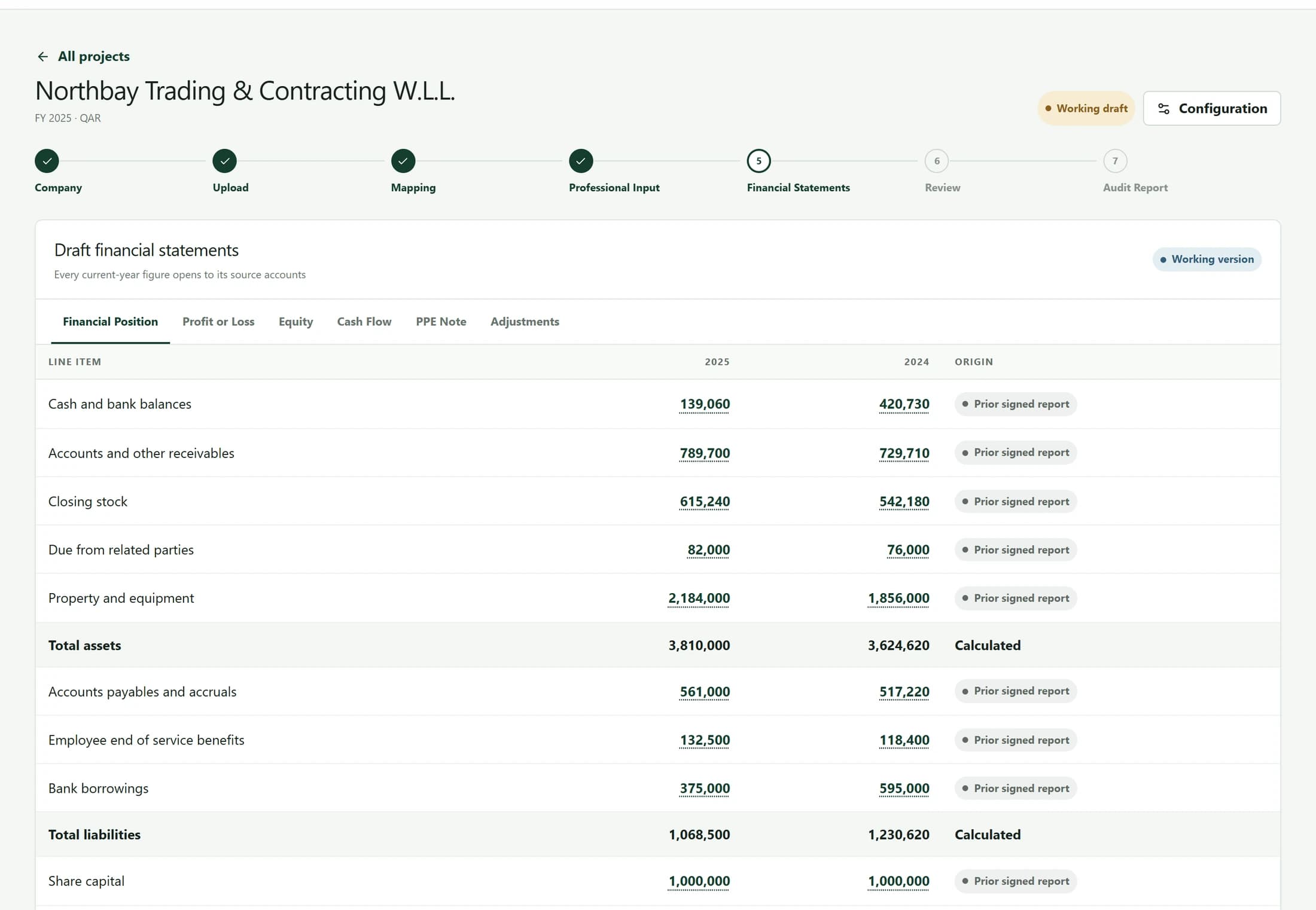
Financial position, profit or loss, changes in equity, cash flow and the property-and-equipment note are constructed from the mapped accounts. The comparative column comes from the prior-year signed report, so the two years are presented on the same headings.
05Professional input
Where a closing balance depends on information that is not in the workbook — additions and disposals, closing inventory, capital movements — the application asks a specific question rather than assuming an answer. The question arrives with the prior-year figures and the current trial-balance figures already shown.
Enter the actual movements needed to reconcile prior audited balances to the current trial balance.
06Validation
A set of calculated controls runs across the project. They are not display states: a failed control blocks approval, and approval is what releases the report stage.
07Reporting
When the statements are approved, the report is prepared from that frozen snapshot: cover, contents, auditor's report, statements, notes and the ownership table. Financial tables in the report are bound to the approved version — the report never recalculates them.
The statements
Change a mapping, an answer or an adjustment and the statements, the PPE note and the cash flow are recalculated together. The comparative column is not typed in — it is carried from the prior-year signed report.
Assets, liabilities and equity with the audited comparative column.
The application
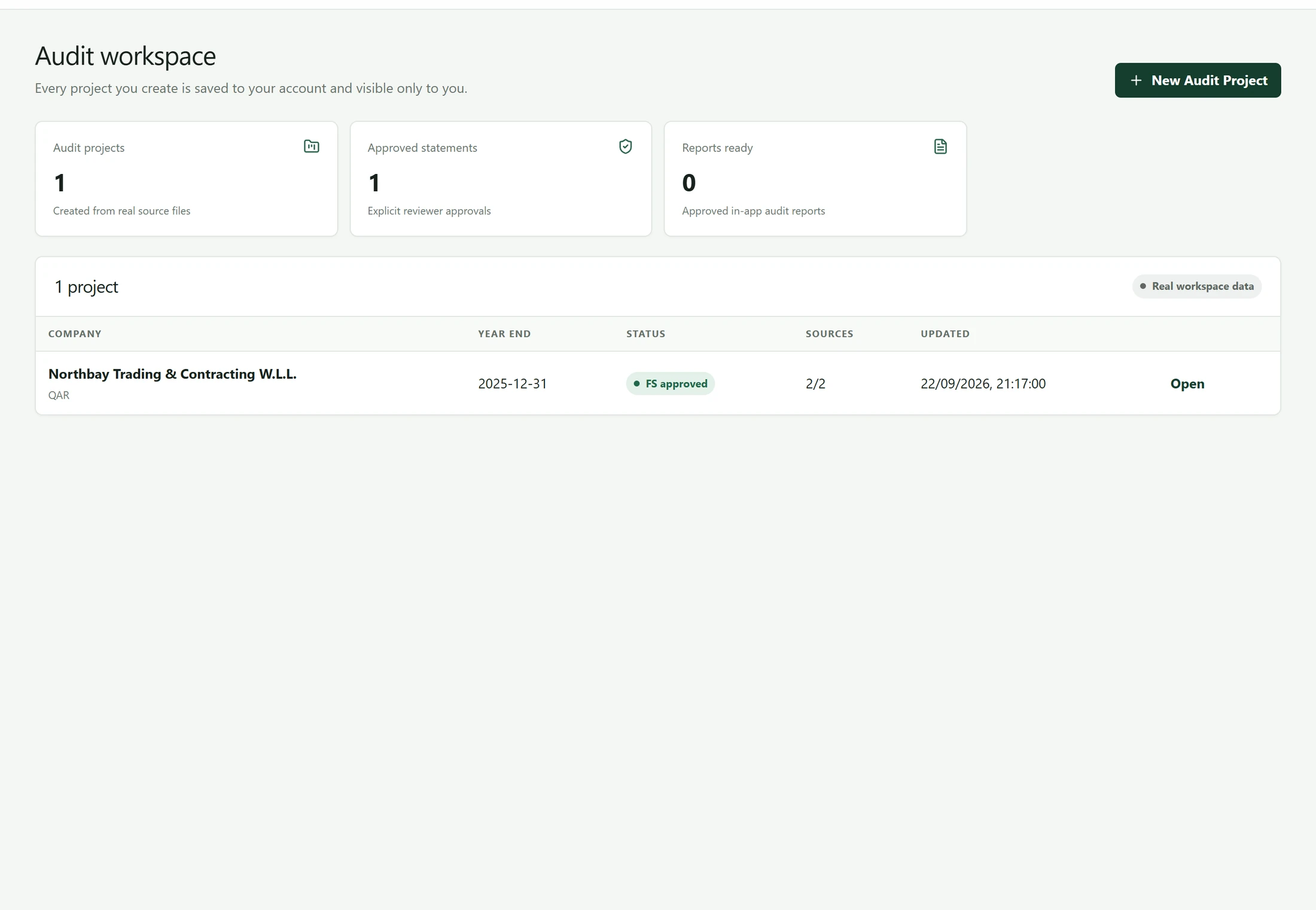
47 Financials is an invite-only application. What follows is the running product on the demonstration engagement — the workspace, the source documents arriving, the imported trial balance and the report being assembled.
AI and rules
47 Financials uses a language model for reading and suggesting, and deterministic code for everything that becomes a figure. The two are deliberately separated.
Model responses are schema-validated before use, and the vendor key stays on the server.
Classification suggestions are never written into a calculation directly — a mapping is a record a person can see and change.
Reliability
A reporting tool is only as useful as its willingness to stop. These are the rules the application is built around — they are the reason the workflow has gates instead of shortcuts.
Financial values are calculated with decimal arithmetic. JavaScript floating point is never used for an accounting amount.
Model output is schema-validated and limited to reading and suggesting. It does not feed the statements, the cash flow or the report tables.
The imported trial-balance rows are never edited. Splits, adjustments and materiality overrides are separate records, each with its reason.
Report generation stays unavailable until the statements are approved, and a later change to a source, mapping or answer invalidates that approval.
When a comparative or cash-flow value cannot be established, the project says so and blocks report generation. It does not substitute a silent default.
The audit opinion comes from the firm's own uploaded template. The auditor's identity and signature remain a professional responsibility.
Where the information needed for a figure is not present, 47 Financials says so — a comparative stays unknown and report generation stays blocked. Nothing is quietly filled in to keep the process moving.
Before and after
This is not a claim that professional judgement disappears. It is a claim about where the time goes.
The repetitive processing becomes software. The judgement stays where it belongs.
Who it is for
47 Financials is being built with the people who prepare and review statements, and it is deliberately narrow: it prepares statements and reports, it does not post transactions and it does not form an opinion.
We are not claiming a client list. 47 Financials is built at Forty Seven Lab, and the workflows it is designed for are described below rather than implied by logos.
Preparing a set of financial statements from a trial balance and last year's signed report.
Repeating the same statement and report preparation for many clients each year.
Closing the year and needing the statements, the notes and the comparatives to agree.
Where a client's workbook arrives in whatever shape the client keeps it in.
Built continuously
The product is in active development. These three lists are kept honest and separate.
Contact
Tell us how you prepare statements and reports today — what arrives from the client, what you rebuild by hand, and where the time goes. If it is a fit for 47 Financials, we will show you the workflow on your own kind of file. Access to the application is invite-only.
Access to the application is invite-only. Messages go to the Forty Seven Lab team, not to a sales queue.